"It's about the kids. Merlyn gets me closer to them and that makes all the difference."
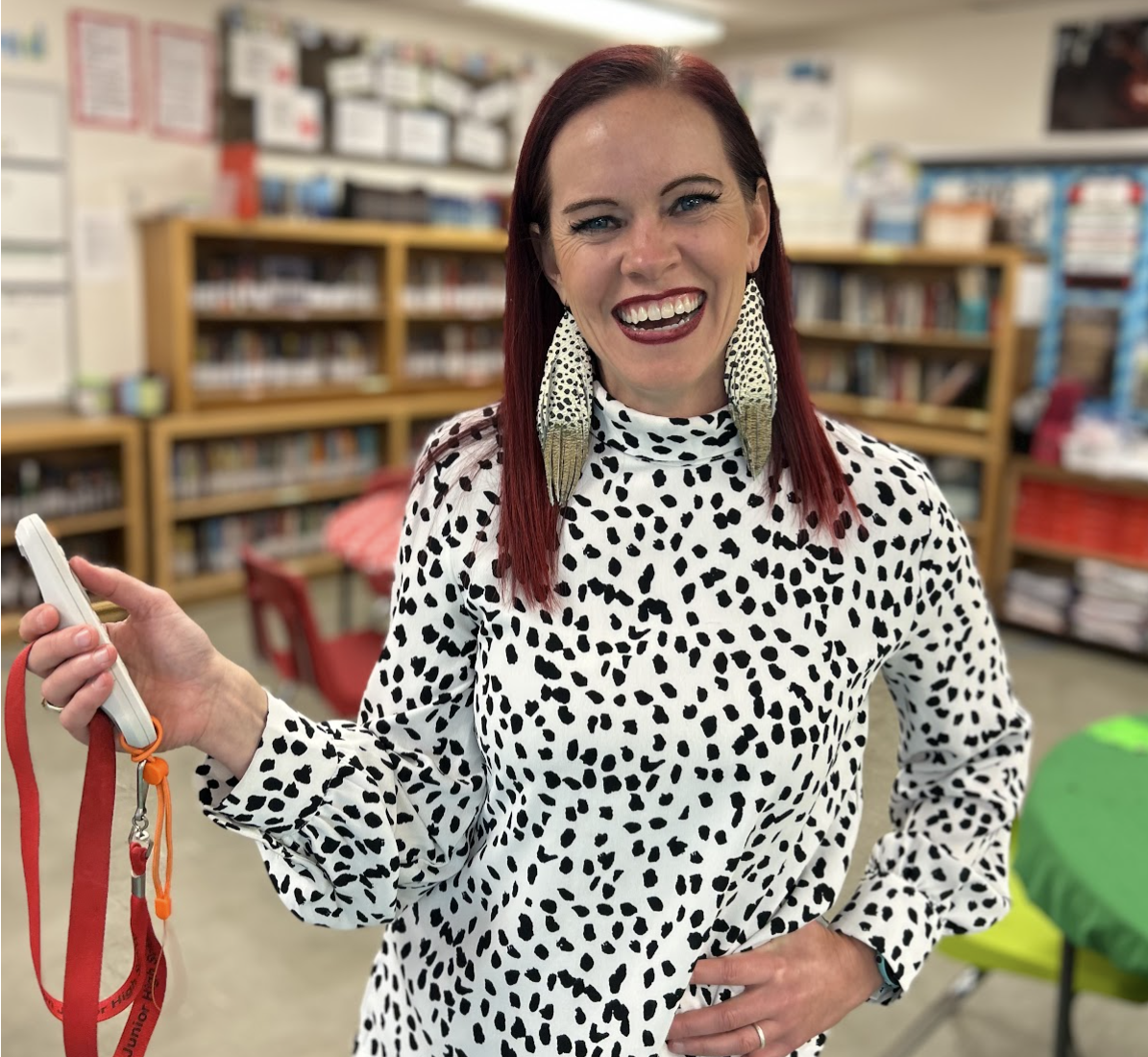
Nancy Henkes has been teaching long enough to know what works. Walk into her 8th grade English classroom at Hamilton ISD and you'll notice it immediately: the walls are covered in student-made posters, quotes, and images. Social contracts — agreements each class wrote together about how to treat one another — hang in the corner. It feels less like a classroom and more like a community.
And at the center of it all, Nancy is moving. She's rarely at her desk. She's rarely at the board. She is, as she puts it, in the power zone.
Proximity Is the Point
Every experienced teacher knows that physical presence matters. Being near students keeps them engaged, on-task, and connected. But for years, classroom technology worked against that — pulling teachers to their desks to click through slides, to the board to start a timer, to the computer to search a question a student just asked.
Nancy felt that friction. Before adopting Merlyn, even something as simple as a timer required a trip across the room — or deputizing a student to do it — breaking the momentum of the lesson.
"Prior to Merlyn, I would have to walk over to my timer, or have a student walk to the timer, and start it. Although I had a simple timer, it took time that I could have been using with the students."
Now she just speaks. And she stays exactly where her students need her.
By her own estimate, Merlyn keeps her in the power zone for 97% of her class period. She can start timers while standing next to a student who's drifting off-task. She can pull up images of mosques while leading a discussion about world religions. She can control videos, open curriculum, and manage transitions — all without breaking contact with the room.
The Lanyard Breakthrough
Adoption wasn't instant, and Nancy is refreshingly honest about that.
Her first challenge was physical: how do you hold a remote, a deck of playing cards for student engagement, and a stylus for the Promethean board — all at the same time?
"Pockets are invaluable," she laughs. She wore the remote around her wrist for weeks, wishing it were smaller. Then, one Wednesday, the solution came to her: a lanyard from her desk drawer.
It sounds almost too simple. But that's exactly the point. Nancy's story isn't about high-tech breakthroughs — it's about a teacher finding what works for her workflow and running with it.
Her advice to other teachers hesitant about the learning curve: "Find one or two tools that you know you would use, and get comfortable with those. Then you can add more tools as your teaching allows." She started with timers and keyboard shortcuts. Now she's exploring student sessions, custom GIFs for her color-coded table groups, and real-time curriculum exploration.
Technology Anxiety Is Real
Nancy doesn't sugarcoat her past frustrations with EdTech.
"I was so sick of administrators shoving technology down my throat I wanted to puke."
It's a blunt take, but it resonates with teachers everywhere. The problem was never a lack of willingness to grow — it was the pace and the mandate. Teachers have, as Nancy says, "so many irons in the fire," and their most important one is taking care of students.
What changed with Merlyn wasn't just the tool. It was the autonomy.
"I can learn the program at my own pace. I can perfect one thing at a time. And I can ditch the things that don't work in my classroom."
That shift — from technology as something done to teachers to something that works for them — is what made adoption feel natural rather than forced.
What Students Notice
Nancy teaches students who have grown up with what she calls "two lives: cyber life and physical life." They're not passive observers of technology — they're critical of it.
Overheard in her classroom: students debating whether to trust AI, questioning outputs, laughing when Merlyn occasionally mishears a command. They're not just using the tool — they're evaluating it.
And they've noticed something else: when their teacher can answer questions instantly, when timers appear without breaking the flow, when a spontaneous question leads to a live search — class just works better.
"Are you going to use Merlyn today?" her students ask. That question, Nancy says, tells her everything she needs to know.
Even the students who fall asleep during class — "Typically sleeping students will wake up when Merlyn says something," she notes with a laugh — perk up. They'd rather be critical of Merlyn than critical of the teacher. And that, too, is a win.
What She Wants Administrators to Know
When a building leader walks into Nancy's room, she has a clear message:
"Merlyn matters because it promotes student engagement and exploration. Children are growing up in a world that is centered around technology. If we want to reach students to help them become better citizens for our community and thus the world, we need to meet them where they are."
This isn't about replacing what great teachers do. It's about amplifying it — staying present, responding to curiosity in real-time, managing complex classrooms with precision, and modeling the kind of critical thinking we want students to carry with them long after the bell rings.
Nancy didn't start her career with a Promethean board. She started with an overhead projector and a whiteboard. The tools changed because her students changed — and she changed with them.
"This will work. This will make me a better teacher. I know it."
She was right.
Nancy Henkes is an 8th grade English teacher at Hamilton ISD. Merlyn for Education thanks her and the entire Hamilton ISD community for welcoming us into their classrooms.